MVP Development: Real Timelines, Real Costs, and What to Cut
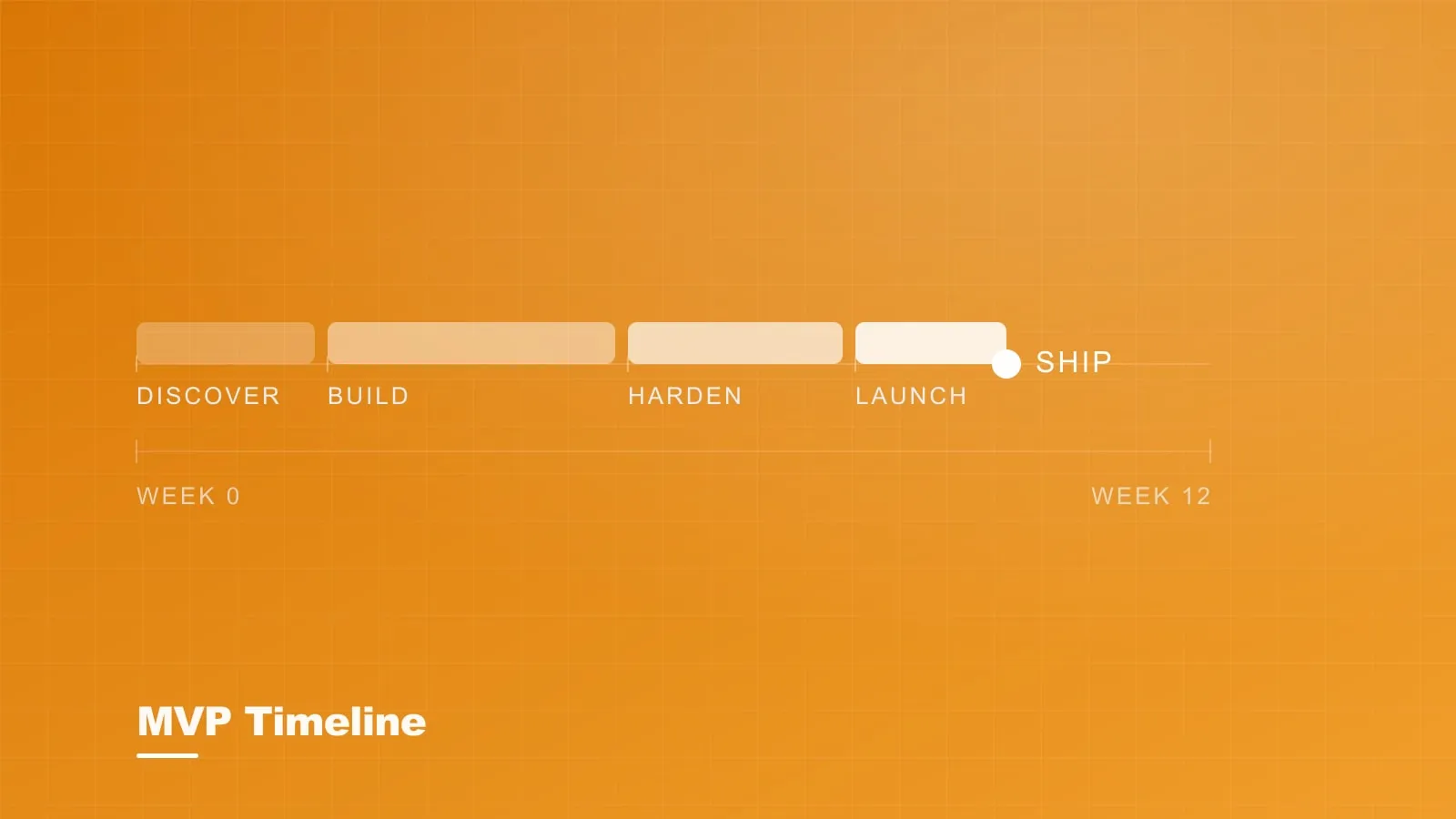
Most MVPs ship in 8 to 12 weeks for $15K to $50K. If yours is taking longer, the scope is wrong. Here is how to cut it without shipping something useless.

In short
A focused MVP typically takes 8 to 12 weeks and costs $15,000 to $50,000. Timelines beyond three months almost always signal scope that is too broad rather than a technical problem. The discipline is choosing one user, one workflow and one outcome, then deferring everything else.
Key takeaways
- Basic MVPs run 4-8 weeks; medium complexity 8-14 weeks; anything past 3 months means the scope is too wide.
- Fix the timeline and flex the scope - the reverse produces launches that slip indefinitely.
- Cut features by user journey, not by feature list: support one complete workflow rather than five partial ones.
- Admin panels, settings screens and edge-case handling are where MVP budgets quietly disappear.
If your MVP has been in development for seven months, you do not have a development problem. You have a scoping problem that has been quietly accumulating since kickoff.
Published estimates are fairly consistent on this: most MVPs ship in 4 to 12 weeks, with basic builds at 4-8 weeks and medium complexity at 8-14. That range is not a stretch goal. It is what a focused MVP looks like when someone has been disciplined about scope.
What the numbers actually look like
| MVP type | Timeline | Typical cost | What it includes |
|---|---|---|---|
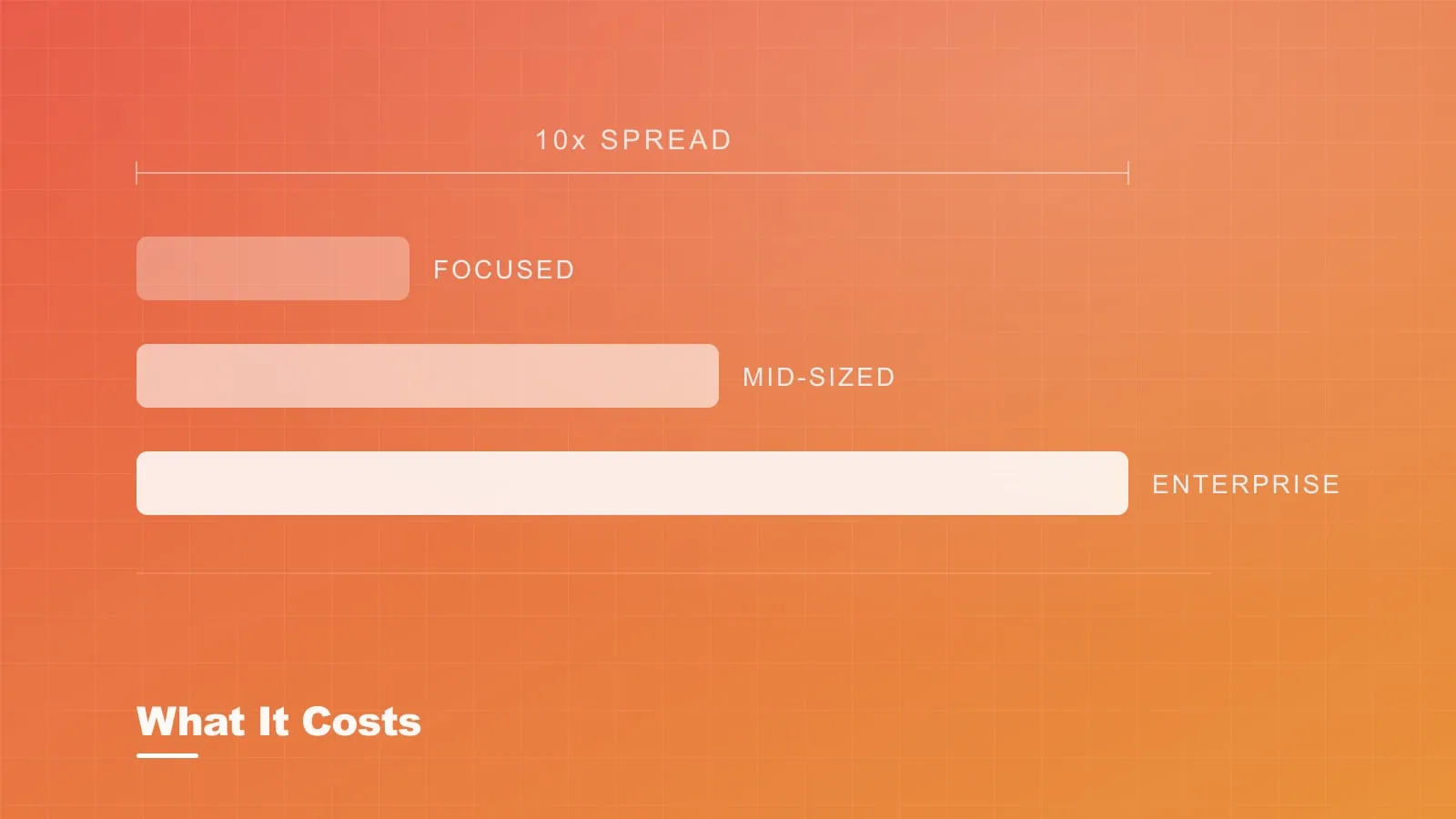
| No-code validation | 4-8 weeks | $5K-20K | One workflow, off-the-shelf components, manual back office |
| Basic custom | 4-8 weeks | $10K-25K | Core feature set, one user type, minimal design |
| Medium complexity | 8-14 weeks | $25K-60K | Integrations, two user types, web plus responsive |
| Complex / regulated | 3-6 months | $60K-140K+ | AI, real-time data, compliance layer, audit requirements |
The honest read on this table: if you are quoting three months and $80,000 for what you call an MVP, it is not an MVP. It is a version one product, and calling it an MVP mostly serves to make the scope feel smaller than it is.
That is not automatically wrong. Some products genuinely cannot be meaningfully tested in a smaller slice. But name it accurately, because the naming affects how you make trade-offs for the next three months.
Fix the time, flex the scope
The single most useful discipline in MVP work is inverting the usual constraint.
Most projects fix the feature list and let the date move. Everyone agrees on what will be in it, and the launch slips - first by two weeks, then by six, and the scope grows the entire time because there is no forcing function.
Fix the date instead. Ten weeks. Then the only question at every decision point becomes does this fit? - which is a question with an answer, unlike is this important?, which is a question every stakeholder answers yes to.
This works because MVP scope is not really a plan. It is a hypothesis about what is minimum, and hypotheses should be cheap to test.
Cut by journey, not by feature
The common failure mode is cutting features from a list until the list is short enough. That produces a product where five workflows all half-work, which teaches you nothing because users cannot complete any of them.
Cut by user journey instead: pick one user, one job, and support it completely.
A recruitment platform MVP might support only “a recruiter posts a role and receives applications.” No candidate profiles, no messaging, no analytics, no employer branding. One journey, working end to end, for one user type. That is testable. Five partial journeys are not.
The test for whether you have cut correctly: can one real user get one real outcome without you intervening? If yes, you have an MVP. If the answer requires “and then we do that part manually,” you might still have an MVP - manual back offices are legitimate and often smart - but be deliberate about it rather than surprised by it.
Where MVP budgets actually disappear
The overruns are rarely in the interesting parts. They accumulate in:
Admin panels. Teams build a full internal interface for a product with eleven users. For the first months, query the database directly or use a generic admin tool. This alone routinely accounts for 20-30% of an MVP build.
Settings and preferences. Every toggle is a feature with its own states and edge cases. Ship with sensible defaults and no settings screen at all.
Onboarding flows. Multi-step wizards, tooltips, progress tracking. With your first fifty users, onboarding is a call with you.
Edge-case handling. Production software needs to handle everything. An MVP with fifty known users needs to handle the main path and fail gracefully elsewhere. This is a genuine trade-off, and the right answer differs by risk - but pretending it is not a choice is how timelines double.
Notifications. Email, in-app, digest, preferences, unsubscribe. An enormous surface area for something you can start by sending manually.
What not to cut
Three things are false economies, and cutting them costs more than it saves within about six months.
Authentication done properly. Use an established provider. Rolling your own auth to save a week is one of the reliably bad trades in software.
Basic error monitoring. Without it you will be debugging user reports blind, which costs more time than the setup did.
A deployment pipeline. Manual deploys are fine for one week and corrosive by week six.
These are cheap now and expensive to retrofit. Almost everything else can wait.
Should you start with no-code?
Often, yes - and founders skip this step more from pride than from analysis.
No-code MVPs typically take 4 to 8 weeks and cost $5,000 to $20,000, which is a cheap way to answer the only question that matters early: does anyone want this?
Start with no-code when you are validating demand, when the workflow is standard rather than novel, when you expect the concept to change substantially, or when you are pre-funding and the cost difference is existential.
Go straight to custom code when the technical approach is the product, when you have compliance or data-residency constraints no-code platforms cannot meet, when you already have committed customers, or when the thing you are testing is specifically whether it can be built.
The common mistake is treating no-code as a lesser choice. Validating with no-code and rebuilding later is frequently the cheapest path to the same destination - you rebuild knowing exactly what to build, which is worth more than the rebuild costs.
The opposite mistake is staying on no-code past the point where the platform is fighting you. The signals are consistent: workarounds accumulating faster than features, per-record costs becoming material, or a required integration the platform will not support.
Choosing who builds it
For a founder without a technical co-founder, this decision matters more than the scope.
A freelancer is cheapest per hour and carries the most delivery risk. No bench, so illness or a competing contract stalls everything, and you absorb project management and architecture decisions yourself. Works well when scope is genuinely fixed and you can specify clearly.
An agency costs more and carries less delivery risk. You are buying continuity, process and someone else holding the plan. Worth it when scope will move - which for an MVP it always does.
An in-house hire is the most expensive route to a first version and the best route to a fifth. Hiring an engineer to build an unvalidated MVP is usually premature.
Whichever you choose, three things predict success better than portfolio quality: whether they push back on your scope (a partner who agrees with everything is not thinking), whether they will do paid discovery before quoting, and whether they name risks unprompted. The reasoning behind that last one is covered in selling technical projects - it works as a buying filter just as well.
After the MVP
Two things reliably go wrong at this point.
The first is treating the MVP as version one of the real product and building on it indefinitely. MVPs are built with deliberate shortcuts. Some of those need repaying before the codebase becomes the constraint.
The second is the opposite - throwing it away because it is “messy” when it is working fine. Rewrites are how promising products lose a year.
The useful question is which shortcuts are now costing you weekly. Repay those and leave the rest.
If the MVP validated and you are scoping the real build, the tiers in what custom web apps actually cost are the right frame. And before extending scope much further, it is worth re-running the build versus buy question - some of what you were about to build has since become purchasable.
Why MVPs actually slip
When an eight-week MVP becomes six months, the cause is rarely technical. Four patterns account for most of it.
Decisions waited on the founder. Development stops while someone waits three days for an answer about how a feature should behave. Across a project, this accumulates into weeks. The fix is a standing decision slot - a fixed daily or twice-weekly window where every open question gets resolved.
“While we’re in there” additions. Each is small. Each is reasonable. Collectively they are the single largest source of MVP overrun, and they are hard to refuse because no individual request is unreasonable. A fixed launch date is the only reliable defence, because it converts every request into a trade rather than an addition.
Design ran ahead of build. Designs were approved without engineering input, then turned out to be expensive to implement. Have whoever is building review designs before sign-off, not after.
Third-party surprises. An API was less capable than documented, a sandbox took three weeks to provision, a compliance review nobody scheduled. Identify every external dependency in week one and start the slow ones immediately - provisioning and approvals do not care about your timeline.
None of these are engineering problems, which is why adding developers does not fix them. They are coordination problems, and they are best addressed before kickoff rather than diagnosed in month four.
The one-question test
Before approving any MVP scope, ask: what specific thing will we know at launch that we do not know now?
If the answer is vague - “whether people like it” - the scope is not testing anything and will keep growing, because nothing in it is disciplined by a question. If the answer is specific - “whether recruiters will pay to post roles without candidate search” - you can cut everything that does not serve it.
That question is worth more than any estimation technique.
What to measure after launch
An MVP that ships without a measurement plan answers nothing, and this is a surprisingly common outcome - the launch consumes all the attention and nobody defined success beforehand.
Decide, before launch, on one primary number. Not a dashboard. One number that tells you whether the hypothesis held: activation rate, repeat usage in week two, conversion to paid, or completion of the core workflow. Vanity metrics like signups and page views feel like progress and answer nothing, because they measure your marketing rather than your product.
Set the threshold in advance too. “We will continue if 30% of signups complete the core workflow within 7 days” is a decision rule. “We will see how it goes” is how a failed MVP turns into eighteen months of incremental additions, each justified by the last one not having been given a fair chance.
Give it 4 to 6 weeks of real usage before judging. Less than that and you are reading noise; much more and you are avoiding the decision.
It is also worth noting that AI tooling has made this discipline harder rather than easier. When building was slow, the schedule enforced scope control for you. Now that a feature can be generated in an afternoon, nothing external stops scope from growing - which is one of several ways AI changed less about building than the headlines suggest.
FAQ
Frequently asked questions
How long does it take to build an MVP?
Most MVPs take 4 to 12 weeks from kickoff to launch. A basic MVP with core features only typically runs 4 to 8 weeks, while medium complexity builds with multiple integrations or both web and mobile interfaces usually need 8 to 14 weeks. Builds involving AI, real-time data or compliance layers commonly take 3 to 6 months.
How much does an MVP cost to build?
Typical ranges run $10,000 to $50,000 for a focused MVP, with basic builds at $10,000 to $25,000 and more complex production MVPs reaching $45,000 to $140,000 in higher-cost markets. The main variables are feature count, whether mobile is included, how much design work is needed, and the team location.
What should I cut from my MVP?
Cut anything that is not part of the single workflow you are testing. In practice that means admin panels (use the database directly at first), settings and preferences, onboarding flows, notification systems, and most edge-case handling. Support one complete user journey rather than five partial ones.
Should I build an MVP with no-code first?
Often yes, if the goal is validating demand rather than proving technical feasibility. No-code MVPs typically take 4 to 8 weeks and cost $5,000 to $20,000, which is a cheap way to learn whether anyone wants the thing. Move to custom code once you have paying users and are hitting real platform limits.

Written by
Jeevan Kumar
Founder, FlowLaunch
Jeevan has spent nine years building and scaling digital businesses, most recently taking a services company from zero to seven figures without outside funding. He writes about the systems underneath growth, not the tactics on top of it.
- 9 years operating
- Bootstrapped to 7 figures
- 40+ growth engagements