How B2B Manufacturers Are Rebuilding Their Digital Operations
Manufacturing buyers research like consumers but buy like procurement teams. What that changed about manufacturer websites, and what most still get wrong.


In short
Manufacturing buyers now complete most of their evaluation before contacting a supplier, which turned the manufacturer website from a brochure into the primary qualification surface. The winning pattern is specification-level product data, self-serve quoting, and integration with ERP - not a visual redesign.
Key takeaways
- Buyers self-qualify before first contact, so missing specification data removes you from consideration silently.
- The highest-return build is usually a product data and quoting layer, not a homepage redesign.
- ERP and PIM integration is what separates a working system from a website that needs manual updating.
- Distributor conflict is the real blocker in most manufacturing digital projects, not technology.
The most consequential change in B2B manufacturing over the last decade was not automation on the factory floor. It was that the buyer stopped calling.
Industrial buyers now research, shortlist and largely decide before contacting a supplier - the same behaviour consumers adopted years earlier, applied to purchases worth six figures. The manufacturer’s website stopped being a brochure that supported the sales team and became the surface on which the company gets qualified or eliminated.
Most manufacturer websites have not caught up to that.
What changed about the buying process
The old sequence was: buyer identifies a need, calls two or three known suppliers, and sales engineers work through specifications together.
The new sequence is: buyer searches for a specification, finds suppliers who publish that specification in a findable form, shortlists three, and contacts them already knowing what they want. By the time you hear from them, most of the decision has been made.
The critical consequence is that elimination is now silent. A supplier who did not publish their tolerance ranges or material certifications does not get a rejection - they simply never appear. There is no lost-deal report for a conversation that never started, which is why this shift took so long to register internally.
What the leaders actually built
The pattern among manufacturers who have handled this well is consistent, and it is not a visual redesign.
Specification-level product data, published and findable. Not a PDF catalogue. Structured data, filterable by the attributes buyers actually search on - dimensions, materials, tolerances, certifications, compatibility. This is the single highest-return investment and it is almost entirely a data problem rather than a design one.
Self-serve configuration and quoting. Not necessarily checkout. Let a buyer specify what they need and receive either a price or a routed enquiry with the specification already captured. This shortens the sales cycle substantially and, importantly, captures buyers who would not have picked up the phone.
Integration with the systems of record. Pricing, stock and lead times live in ERP. Product data lives in a PIM if the company is mature, and in a spreadsheet if it is not. A site not connected to those either displays stale information or requires manual updating - and manual updating always degrades, because it is nobody’s actual job.
Documentation as a channel. CAD files, installation guides, compliance certificates, datasheets. Engineers search for these constantly, and manufacturers who publish them well capture a stream of highly qualified traffic that competitors are sitting on in a login-gated portal.
The obstacle is rarely technical
Manufacturing digital projects stall more often on channel conflict than on engineering.
If distributors represent a large share of revenue, anything resembling direct sales is a political problem before it is a technical one. Projects get scoped, approved, and then quietly reduced to a homepage refresh because nobody wants to have the distributor conversation.
The manufacturers who get through this generally decide the channel model before scoping the build:
- Quote-and-route - buyers configure online, enquiries route to the appropriate distributor. Preserves the channel and captures the demand.
- Direct for spares and consumables only - low-value, high-frequency items direct; project business stays with distribution.
- Full direct - viable when distribution is not load-bearing, and rarely worth the disruption when it is.
Any of these can work. What does not work is starting the build before deciding, which produces a system that serves neither model.
Why this is mostly a data project
The uncomfortable finding for most manufacturers is that the work is not on the website at all.
If product specifications live across engineering drawings, three spreadsheets and one person’s institutional memory, no amount of front-end work will produce a filterable product catalogue. The build has to start with consolidating product data into something structured - which is unglamorous, hard to get budget for, and the actual determinant of whether the project succeeds.
This is a specific case of a general pattern in build-versus-buy decisions: a PIM platform may well cover the boring 70% here, leaving a much smaller custom build on top. It is worth testing that before commissioning something bespoke.
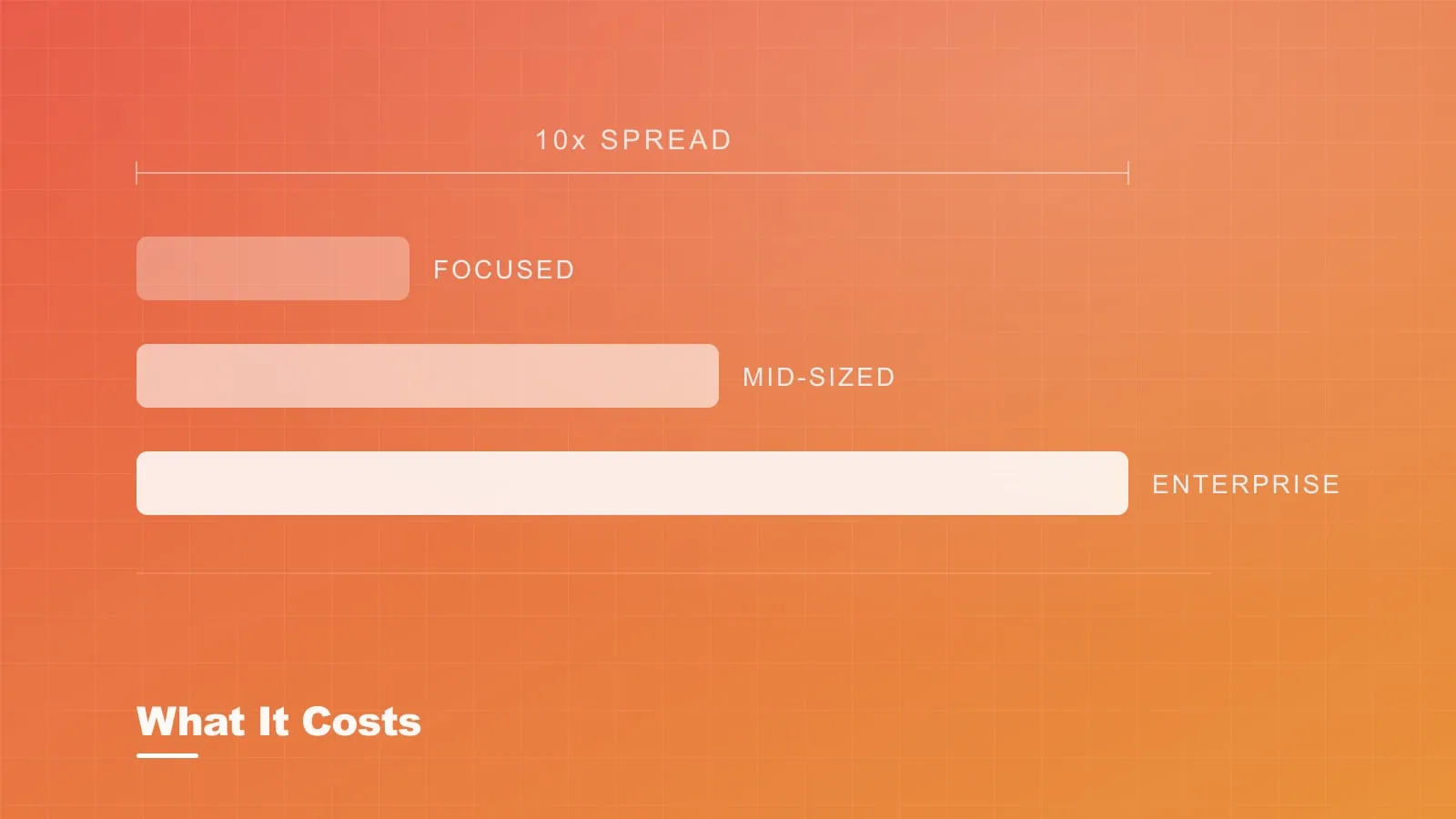
It also explains why quotes for these projects vary so widely. A supplier who has understood the data problem quotes for it. One who has looked only at the front end quotes for a website, and the difference reappears as change requests in month three - the exact dynamic described in why development quotes vary 10x.
A sensible sequence
- Audit what a buyer can currently find without contacting you. Search for your own products the way a buyer would. This is usually the moment the problem becomes real internally.
- Decide the channel model. Before scoping. In writing.
- Consolidate product data. The unglamorous prerequisite. Budget properly for it.
- Publish specifications and documentation. Findable, structured, not gated. This alone often produces measurable enquiry volume.
- Add configuration and quoting. Once the data underneath is trustworthy.
- Integrate with ERP. So it stays trustworthy without someone maintaining it manually.
Most manufacturers attempt this in reverse - starting with a redesign, discovering the data problem, and stopping.
What this looks like elsewhere
The same pattern is playing out across industries with technical products and long sales cycles: distribution, industrial services, specialist B2B suppliers. The specifics differ, but the structure is identical - buyers self-qualify earlier, the website becomes the qualification surface, and the real constraint turns out to be product data rather than design.
If your enquiry volume has been flat while your market has not shrunk, it is worth checking whether you are being eliminated in a phase you cannot see. That is also the point at which page performance and technical SEO stop being a marketing concern and start being a revenue one.
How to tell whether this applies to you
Three checks, none of which need a consultant.
Search for your own product the way a buyer would. Not by your brand name - by the specification. A material, a dimension, a certification, a compatibility requirement. If you do not appear and three competitors do, you have your answer.
Ask your sales team what buyers already know on the first call. If prospects consistently arrive having compared you against named competitors, the evaluation is happening before you are involved, and the only question is whether your published information is helping or absent.
Count how many steps it takes to get a price. If the answer is “fill in a form and wait two days,” you are losing the buyers who had three suppliers to contact and stopped at the one who answered immediately.
If all three come back badly, the fix is a data and publishing project, not a redesign - and it is usually cheaper than the redesign you were considering, because the expensive part is work you would have had to do anyway.
FAQ
Frequently asked questions
Why do manufacturers need more than a brochure website?
Because buyers now complete most of their evaluation before contacting any supplier. If your specifications, tolerances, materials and lead times are not accessible online, you are eliminated during a research phase you never see. The website has become the qualification surface rather than a marketing asset that supports the sales team.
Should manufacturers sell directly online?
Not necessarily, and for many it would damage distributor relationships. The higher-value move is usually self-serve quoting and configuration rather than checkout - letting buyers specify what they need and get a price or a routed enquiry. That captures the demand without bypassing the channel that fulfils it.
What is the biggest obstacle to manufacturing digital projects?
Channel conflict, far more often than technology. Direct digital sales threaten distributor relationships that may represent the majority of revenue, so projects stall in internal politics rather than engineering. Projects that succeed usually define the channel model before scoping the build.
What does ERP integration add to a manufacturer website?
It makes the data trustworthy without manual work. Pricing, stock, lead times and specifications live in ERP or PIM systems, and a site not connected to them either shows stale information or requires someone to update it by hand. Integration is usually what separates a system people rely on from one that quietly falls out of date.

Written by
Jeevan Kumar
Founder, FlowLaunch
Jeevan has spent nine years building and scaling digital businesses, most recently taking a services company from zero to seven figures without outside funding. He writes about the systems underneath growth, not the tactics on top of it.
- 9 years operating
- Bootstrapped to 7 figures
- 40+ growth engagements